

28% Fewer Meetings: Inside the World Cup's Grip on the Workday


Somewhere out there, a project manager is staring at a mostly-empty meeting room, wondering where everyone went.
A couple of weeks ago, our workplace data turned up something odd. Meeting volume wasn't just easing off, the way it typically does in July. It was falling off a cliff, steeper than previous summers, and far beyond what vacation season alone could explain. Something else was clearly rearranging the workday, and it wasn't showing up on anyone's calendar.
Kick Off Time
The answer, it turns out, had been on television for weeks. The Men's World Cup began on June 11th, and evidently offices around the world have been quietly reorganizing themselves around it ever since.
This year's tournament makes an unusually good case for itself. The 2026 edition is the first-ever 48-team World Cup, staged across three host countries over 39 days, from June 11 to July 19.
That expansion means a lot more soccer: 104 matches this year, up from 64 in past tournaments, a 62% increase in games.
In practice, that means there's a match on nearly any given weekday, and someone in your building probably cares about it. Few events on the calendar command this much attention, from this many people, for this long.
The Numbers Even Surprised Us
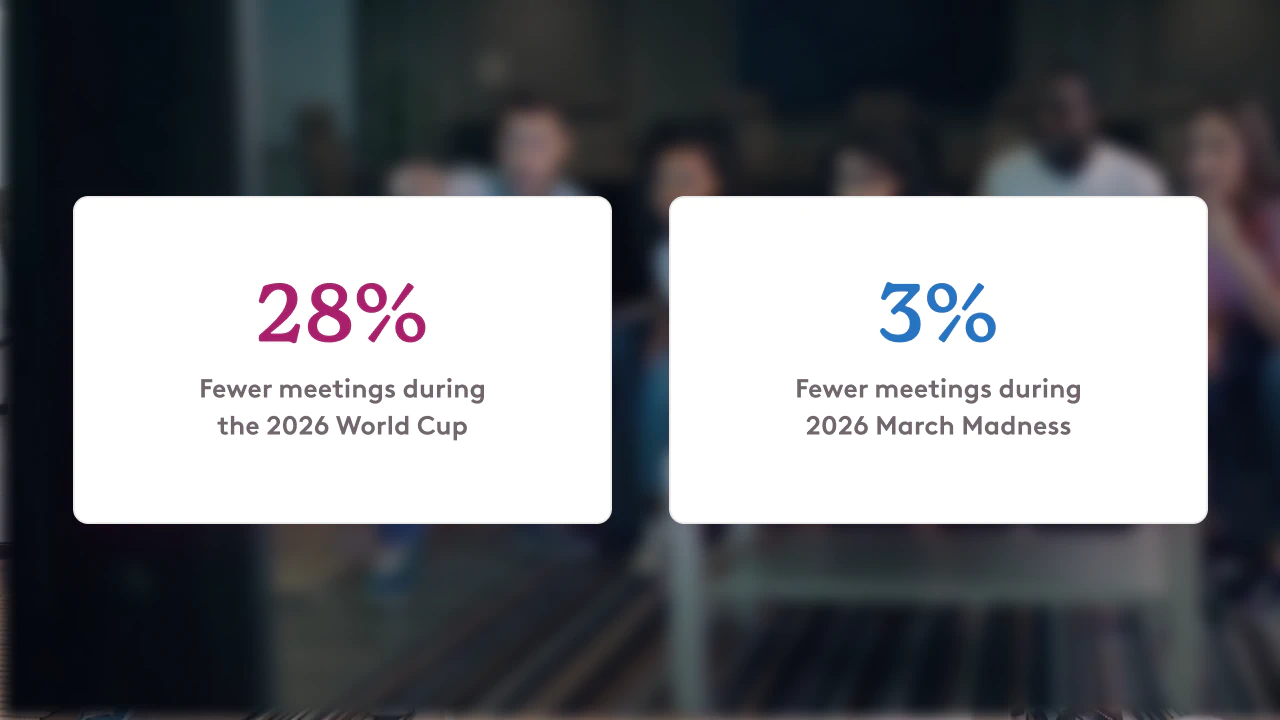
Since the tournament began, we’ve seen the number of meetings held at workplaces globally has dropped 28% compared to the expected number of meetings during that time frame.
Put plainly: nearly a third of the meetings that would normally be happening right now aren’t.
And the effect varies by geography in a way that tracks almost perfectly with soccer fandom:
- North America: -19% — the smallest decline of the three regions measured
- Europe: -31% — where many matches kick off late at night, which may be affecting the following day's schedule
- South America: -35% — the largest decline of any region measured
These aren't isolated numbers, either. They line up with just how much attention this tournament has been pulling in globally. The 2026 World Cup has already broken the all-time attendance record for the sport, drawing more than 3.6 million fans through stadium gates so far.
American television audiences have been just as enthusiastic: the USMNT's Round of 16 match against Belgium on July 6 pulled in 30 million viewers on Fox, making it the most-watched soccer broadcast in U.S. history. Group-stage matches averaged nearly 5.1 million U.S. viewers apiece, a 92% increase over 2022.
World Cup vs. March Madness
In the US, March Madness has long been considered the reigning king of workplace disruption, thanks to a massive slate of games that tips off at noon on a Thursday and doesn't let up for weeks.
To see how it actually stacks up, we looked at workplace attendance and meeting activity on the first Thursday of March Madness and compared it to the previous three Thursdays. The result: a very slight dip of 2–3% in meeting activity in North America, and, as expected, no meaningful impact globally.
Put simply, March Madness isn't even a blip on the radar next to the World Cup.
The Office Isn't Emptying Out. It's Just Being Used Differently.
In an interesting twist, according to Robin’s data, office attendance hasn't been impacted by the World Cup despite the large dip in meetings.
So rather than skipping work, employees appear to be quietly rerouting their day around the games that matter to them. A couple of patterns explain how.
In North and South America, where many matches kick off in the afternoon local time, the data suggests people are front-loading focused work into the morning, then keeping afternoons deliberately light once the whistle blows.
In Europe, where matches often run late into the night, the effect shows up the next morning instead — a fairly predictable outcome of staying up for penalty kicks on a Tuesday.
Either way, the underlying behavior looks the same: employees are quietly adjusting, unofficially, for the games that matter most to them.
What the World Cup Understands That Most Offices Don't
There's a tactical takeaway buried in all of this: don't schedule your big kickoff meeting between June 11th and July 19th, because you will probably lose your team’s focus. But that's the easy lesson. The more interesting one is about what the World Cup is actually pulling off.
Every company spends enormous energy trying to manufacture the thing the World Cup produces for free: a reason for people to care about the same moment at the same time. Offsites get built around it. Culture budgets get spent chasing it. All-hands meetings open with forced enthusiasm in pursuit of it. And here is a month-long tournament, with no company Slack channel or mandatory RSVP, generating more shared attention on your team than most internal initiatives will manage in a year.
The World Cup is a great reminder of what genuine, voluntary engagement looks like when you see it in the wild (and a useful, if slightly humbling, comparison point for anyone whose job involves getting a room full of people to care about something at 10 a.m. on a Tuesday).
So no, don't schedule that important kickoff meeting during a World Cup game if you can help it. But more importantly, maybe spend some time this month asking what your own workplace would need to earn similar excitement and attention on its own. Figure out where else your team is collectively excited and engaged, and see if you can plan office activities (like World Cup watch parties) around them.
Start by mapping out what your team is already excited about: a big product launch, a rivalry between offices, an industry event, even a shared hobby, and build something around it instead of competing with it.
If watch parties are working, borrow the format: put a game on a screen in a common space, keep it optional, and let people opt in on their own terms rather than mandating attendance. The lesson here isn't to compete with the World Cup. It's to figure out what your own version of it could be.